Dane Poyzer
On this page10 sections
Why do new habits only last a few days? You start one on Monday and by Thursday it's gone. Nothing dramatic happens. You're tired one evening, the day gets away from you, and skipping it costs you nothing.
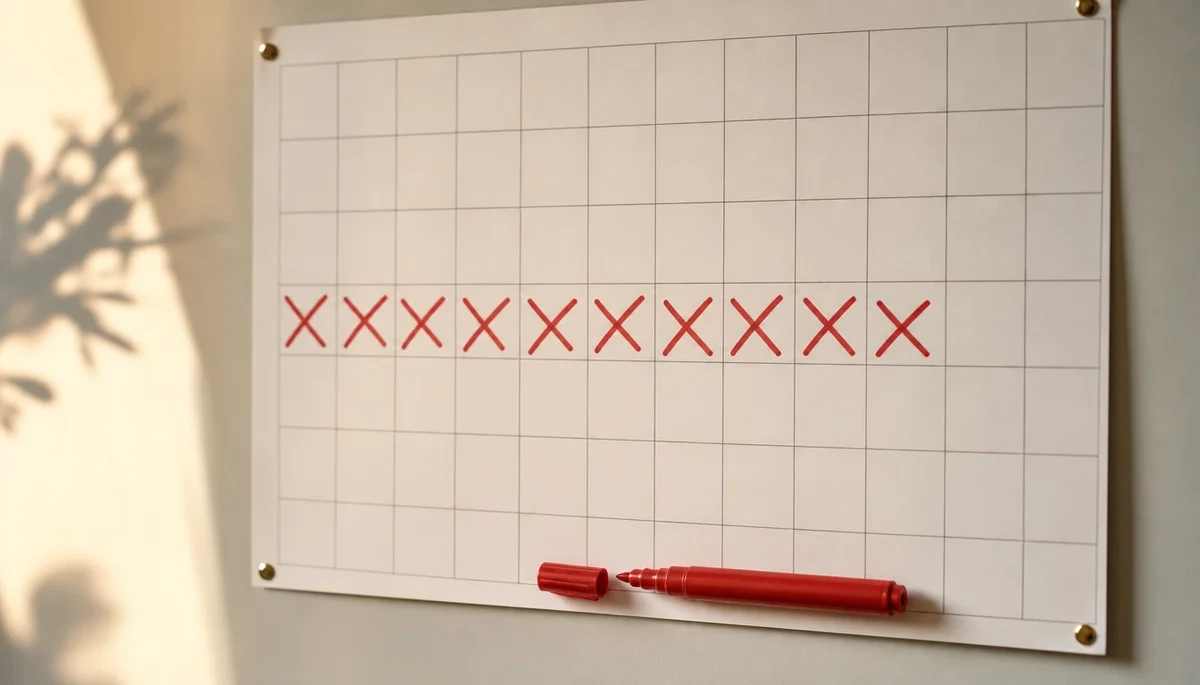
That's the gap "Don't break the chain" fills. At the start there's nothing to lose by skipping a day, so give yourself something. Pick one action. Each day you do it, mark a big red X on a wall calendar. After a few days the Xs form a chain. Now there's something to lose, and your only job is not to break it.
Don't break the chain at a glance
- What it is: a way to keep doing one chosen action every day by marking each day you do it.
- What you need: a wall calendar, ideally with the whole year on one page, and a red marker.
- The rule: do the action, mark the X. Don't break the chain.
- The idea: skipping a day costs nothing at first. Once you have a chain, it does.
- Who it helps: anyone whose new habits fade after a few days.
- The catch: the action has to be small enough to do on your worst day.
Where it comes from (and the dispute)
The story goes that the comedian Jerry Seinfeld passed the idea on to a software developer, Brad Isaac. In Isaac's account, retold by CBS MoneyWatch, Seinfeld told him to get "a big wall calendar that has a whole year on one page", hang it somewhere prominent and buy "a big red magic marker". For each day Isaac did his task of writing, he would put "a big red X over that day".
"After a few days you'll have a chain," the advice goes. "Your only job next is to not break the chain."
Seinfeld has said it wasn't his idea. Asked about it in a Reddit AMA, he called it "the dumbest non-idea that was not mine, but somehow I'm getting credit for it" (quoted by absent.org, January 2014). So treat the Seinfeld part as a story, not a fact. The method itself is the same whoever came up with it.
How to do it, step by step
- Choose one action. Just one. Something you can do every day, like "read a page", "write three sentences" or "walk round the block". It works best when it's a specific action rather than a goal like "get fit".
- Get a calendar you'll see. A wall calendar with the whole year on one page is the classic version, because you can see the chain grow. Hang it where you'll walk past it every day.
- Do the action, then mark a red X. Make the X big. Marking it is the small reward for doing the thing.
- Watch the chain form. After a few days you'll have a row of Xs. Now there's something to lose. In Isaac's account, seeing the chain grow is part of the appeal.
- Don't break the chain. That's the whole job. You don't need to do more tomorrow, or do it better. You only need tomorrow's X.
The catch: pick something small enough for your worst day
The chain asks for one thing every single day, including the days you're tired, ill, busy or away from home. An action that's easy on a good Monday can be impossible on a bad Thursday, and that's usually where new habits go.
So size the action for your worst day, not your best one:
- "Read for an hour" becomes "read a page".
- "Go for a run" becomes "put my trainers on and walk to the end of the road".
- "Write a chapter" becomes "write three sentences".
- "Learn Spanish" becomes "do one lesson".


The small version is the version that counts for the X. You can do more on a good day, but more isn't required. If you're unsure, ask: could I still do this at 10pm after a long day? If not, make it smaller.
This is the same idea dypt is built on: breaking a big task into smaller steps until the next one is easy to start. A habit is just a task you want to start every day.
Which action should you chain?
You can chain anything, but the method only asks for one, so choose carefully. A good test is the thing that would matter most if you did it every day.
If you followed the ABC method, you already have a candidate: your number one A, the task with the most serious consequences if it doesn't get done. When it's work that comes back every day, such as a draft you need to finish or practice for an exam, chain a small daily piece of it.
Once one chain is going, you can start a second calendar for something else. Starting with one keeps it simple.
A worked example
Here's a made-up example. Sam wants to read more. Past attempts at "read for an hour every night" lasted about four days.
| Day | What happened | Mark |
|---|---|---|
| Monday | Read for 40 minutes | X |
| Tuesday | Read a chapter | X |
| Wednesday | Late night out; read one page in bed | X |
| Thursday | Ill and tired; read one page | X |
| Friday | Read for half an hour | X |
| Saturday | Read on the train | X |
| Sunday | Read a page before bed | X |
Wednesday and Thursday are the days the old habit would have stopped. This time the action was "read a page", so one page was enough for the X. The chain survived the bad days, and Friday picked up again.
Common mistakes
- Choosing a goal instead of an action. "Get fit" can't be done in a day. "Walk round the block" can.
- Making the action too big. If it only fits your good days, it may be too demanding on a bad one. Shrink it.
- Chaining too much at once. Five new habits mean five chances to break a chain each day. Start with one.
- Hiding the calendar. Keep it visible so it works as a daily cue. Put it on a wall, not in a drawer.
- Raising the bar as you go. If you start treating your best day as the minimum, the action stops being small. Keep the small version as what counts.
How to do it in dypt
dypt doesn't count streaks yet (streak tracking for repeating tasks is on our roadmap), but its calendar can already show your chain. Give your one action a daily repeating task with a deadline, and each day you complete it appears struck through on that date. A run of struck-through days is your chain, and a day you missed stands out because it isn't crossed off.
- Create the task. Name it with the small version, for example "Read a page".
- Give it an evening deadline. On this original task, set today's deadline to 9pm. The deadline is what puts the task on the calendar. If you want a nudge, add a reminder at or before it. For reminders to reach you, turn on Device notifications on the device you'll use and allow notifications in your browser.
- Set it to repeat daily. Open the task's Repeat dialog, choose Daily, set Every to 1 day and set the start to today. Keep Deadlines selected under Include and Roll forward set to Yes, so each day's copy is due that evening. Press Start Repeating. Each day dypt creates a fresh copy of the task.
- Keep past days visible. Leave Hide old off, because it archives earlier copies and archived tasks don't appear on the calendar. Turn Date suffix on if you'd like the date in each copy's title.
- Tick it, then check your calendar. When you've done it, complete the task in dypt. Open Calendar and today joins the chain. If completed tasks don't show, turn off Hide completed tasks by default in your settings. You can still keep the paper calendar and red pen too.
Repeating tasks are on every dypt plan, including the free plan. Each day's copy counts as a task towards your plan's task limit. For more detail, see how repeating tasks work, the recurring tasks feature page and the repeating tasks docs.
Start your chain today
Pick one action and make it small enough for your worst day. Put a calendar on the wall, do the action, and mark your first X.
If you'd like the daily task to show up on its own and your chain on a calendar, try it in dypt, free to start.
Next in our Do the thing videos: the MoSCoW method, for sorting what must happen from what would be nice. Read the MoSCoW method for task prioritization.
Sources and further reading
- Jessica Stillman, "A Productivity Secret from Seinfeld (and Convicts)", CBS MoneyWatch, updated 29 December 2010
Brad Isaac's account of the calendar, the red X and the chain. - "Seinfeld didn't", absent.org, 20 January 2014
Quotes Jerry Seinfeld's Reddit AMA answer denying the idea was his. - The ABC method for task prioritization
How to find your number one A, the task that matters most. - How to break down large tasks
Making a big job small enough to start.