Dane Poyzer
On this page6 sections
When your task list is too long and your head feels full, simple prioritisation methods can help you decide what actually matters today. The tricky part is that the MIT method, the Ivy Lee method, and the 1-3-5 rule solve slightly different problems, so the best choice depends on the shape of your day, your workload, and how easily you get stuck.
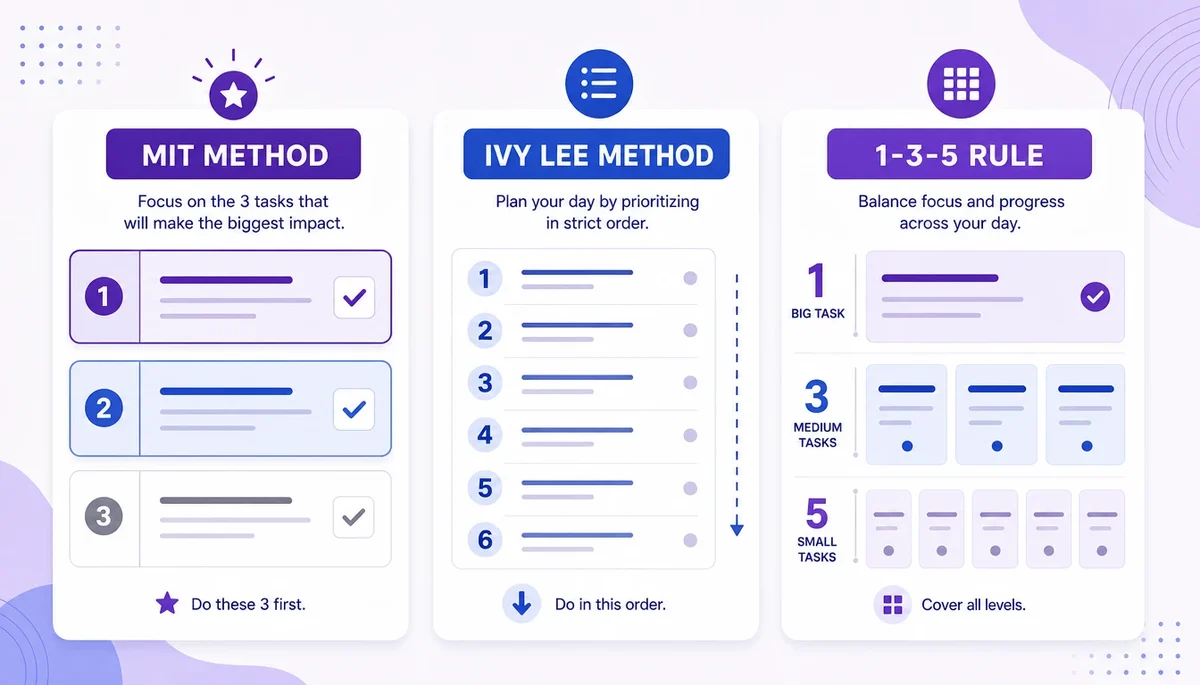
If you have been wondering, MIT, Ivy Lee, or 1-3-5: which prioritization method should you use when everything feels important?, the short answer is this. Pick the MIT method when you need sharp focus on a few outcomes, the Ivy Lee method when you need a very simple plan you will actually follow, and the 1-3-5 rule when you need a realistic mix of big, medium, and small tasks in one day.
| Method | Purpose | Best use case | Strengths | Weaknesses | dypt fit |
|---|---|---|---|---|---|
| MIT method | Identify the few tasks that matter most today | Deep work days, deadline pressure, high-impact work | Clear focus, low decision load, easy to start | Can ignore admin work, vague MITs become stressful | Strong fit with priorities, subtasks, and AI task breakdown |
| Ivy Lee method | Plan tomorrow with a short ordered list | People who freeze when choosing what to do next | Very simple, strong sequence, helpful for task paralysis | Too rigid for reactive days, six tasks may not suit every role | Strong fit with daily planning, drag-to-reorder, reminders |
| 1-3-5 rule | Balance one big, three medium, and five small tasks | Busy mixed days with meetings, admin, and one meaningful task | Better capacity balance, makes small wins visible | Can become a quota, task sizes are easy to misjudge | Strong fit with estimates, task hierarchy, and status tracking |
When the MIT method works best


The MIT method means choosing your Most Important Tasks before other work pulls your attention away. It is not really about doing only three tasks, or any fixed number, but about protecting the few tasks that would make the day count.
This works best when a small number of outcomes clearly matter more than the rest. It is especially useful for writing, studying, planning, project work, or any day where interruptions could easily push important work aside.
The main risk is making your MITs too large or too vague. If an MIT says “sort out project plan”, you may still avoid it because you do not know the first step.
It can also hide routine but necessary work. If you focus only on high-impact tasks, admin, follow-ups, and maintenance jobs can quietly pile up.
A pure MIT method can also feel unrealistic on reactive days. If your role changes by the hour, you may need lighter focus targets rather than a rigid must-finish list.
Where the Ivy Lee method shines


The Ivy Lee method is a daily planning approach where you write down six tasks for tomorrow and do them in order. Its real value is not the number six by itself, but the forced ranking that removes the “what now?” question.
This method suits you when too much choice slows you down more than too much work. It is often helpful if you bounce between tasks, struggle to finish what you start, or deal with ADHD-style overwhelm and executive dysfunction.
Its biggest strength is simplicity. You do not need a complex scoring system, just an honest ordered list and a willingness to start at number one.
The downside is that it can feel too strict if your day is highly reactive. If urgent requests keep landing, a fixed sequence can break early and leave you feeling behind.
Lower-ranked tasks can also roll over for days if you never review them properly. And six tasks may be too many or too few depending on how you size each one.
When the 1-3-5 rule gives you a fuller daily plan


The 1-3-5 rule means planning one big task, three medium tasks, and five small tasks for the day. It tries to match the real shape of a working day, where you often need both meaningful progress and a handful of quick wins.
This works well when your day includes a mix of focused work, maintenance work, and loose ends. It is useful if you often end the day feeling busy but are not sure whether you moved anything important forward.
The big benefit is balance. You give one meaningful task proper space, while still making room for calls, emails, approvals, and other small jobs that would exist anyway.
The catch is that it depends on judging task size well, and most of us are not brilliant at that. What looks like one big task can easily be a whole project in disguise.
It can also turn into a quota. If you feel pressure to fill all nine slots every day, you can end up planning more work than your day can hold.
If your “one big task” is still fuzzy, the rule breaks down fast. You need subtasks, or at least a clear next action, before it becomes something you can actually start.
So, MIT, Ivy Lee, or 1-3-5: which prioritization method should you use when everything feels important?
- If your main problem is lack of focus, lean towards the MIT method.
- If your main problem is deciding what to do next, lean towards the Ivy Lee method.
- If your main problem is fitting different kinds of work into one day, lean towards the 1-3-5 rule.
- If you often underestimate time, use the 1-3-5 rule only if you also add rough time estimates.
- If big tasks feel intimidating, use the MIT method or the 1-3-5 rule only after breaking the big task into smaller parts.
- If your work is reactive, use a lighter MIT method with room for urgent work rather than following the Ivy Lee method too rigidly.
- If you get overwhelmed easily, start with the simplest version you will actually keep using, not the most complete-looking system.
How dypt helps whichever method you pick
All three methods work better when vague work becomes clear next actions. That is where dypt is useful, because you can turn a broad task into a proper task tree, keep priorities and deadlines visible, and use AI when you need help turning a fuzzy project into something you can choose from.
For the MIT method, you can keep one top-level task as today’s priority and break it into small, startable subtasks underneath. Features like Priorities, deadlines, and reminders, Deep task hierarchies and subtasks, and AI task breakdown make that much easier.
For the Ivy Lee method, dypt gives you a simple place to line up tomorrow’s tasks in order and stick to them. If tasks keep rolling over, status changes, reminders, and visible reordering help you spot the pattern rather than pretending the list is still realistic.
For the 1-3-5 rule, estimates matter more than most people think. With Time tracking and AI estimates, you can check whether your one big, three medium, and five small tasks actually fit the hours you have.
I also like that dypt keeps helping when the method starts to strain. If your MIT is still too broad, nested tasks shrink it; if your Ivy Lee list keeps slipping, reminders make that visible; and if your 1-3-5 plan is too ambitious, estimates show it before the day gets away from you.
Wrapping up
None of these methods is the universal winner. The right one is the one that reduces friction for you, matches the kind of day you actually have, and helps you choose a next step without making planning feel like another job.
If you want a flexible way to test any of the three without rebuilding your whole system every time, start using dypt for free.