Dane Poyzer
On this page15 sections
Monthly close is hard enough without rebuilding your checklist from memory while deadlines, review notes, and client follow-ups all compete for attention. If you have already mapped your month end close process in Part 2, this guide will help you turn that map into a monthly close checklist you can reuse, improve, and trust when the close gets busy.
Prerequisites
- A mapped close process for one client, entity, or reporting routine
- The phases, outputs, common exceptions, and recurring notes from that map
- Access to recent close files or support so you can check what really happened
- A place to build the checklist, such as dypt, a document, or a spreadsheet
Materials & tools
- Your close process map from Part 2
- Any existing monthly close checklist, tracker, or working paper index
- A recent completed close for comparison
- Notes on recurring questions, evidence needs, and handoffs
- Optional: the copyable monthly close checklist as a starting point
1. Start with the close outcome, not the task list
A good checklist starts with the result, not with a pile of familiar actions. If you define what finished means first, you stop adding tasks just because they were on last month’s sheet.
Write a short outcome statement for this close. That might be management accounts issued, key balance sheet accounts reconciled, review points logged, client pack sent, and carry-forward items captured.
When I worked in finance, the strongest checklists were the ones tied to a clear output. If you can point to the finished pack and say, “this is what done looks like”, the rest of the list gets much easier to shape.
2. Create one root checklist for one close routine


One strong checklist for one routine is far more useful than a giant template that tries to cover every client and every exception. It gives you a clear source of truth when the close is moving quickly.
Create a single top-level item named for the routine you are building, such as Monthly close checklist - Client A or Group management accounts close. Add the close objective, expected outputs, and any setup context another accountant would need before starting.
A client-specific root works well because it keeps the month end close process visible and reusable instead of forcing you to rebuild it. You also make it easier to share the same structure with a manager or teammate without losing the logic behind the work.
3. Build the checklist phase by phase
This is the point where your map becomes usable. A month end close process only helps during the live close once you turn its phases into a structure you can work through.
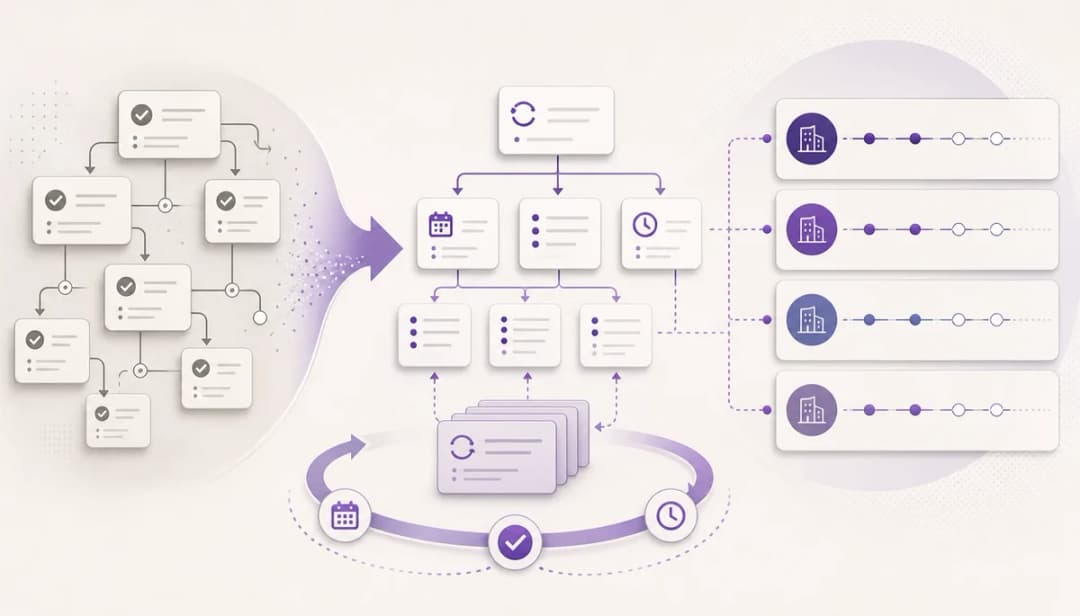
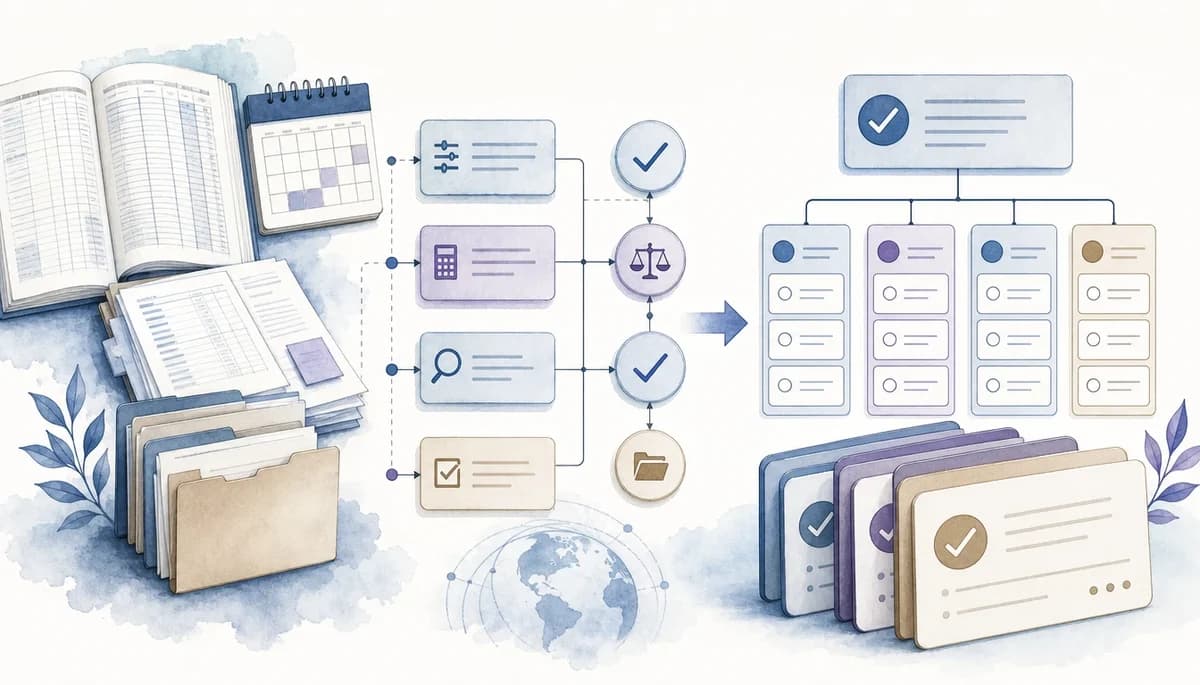
Take the phases from your map and make each one a parent task. Common sections include pre-close preparation, input collection, reconciliations, journals and adjustments, reporting pack, review notes, and carry-forward items.
This gives your month end close checklist a shape that matches the real work. Instead of scrolling a flat list of 80 items, you can jump straight to the part of the close that needs attention.
4. Convert repeated work into action-sized subtasks


Small, clear tasks reduce friction when you are busy or interrupted. If the next action is obvious, you spend less time deciding what to do and more time moving the close forward.
Under each phase, add the recurring actions that happen most months. For a reconciliation section, that might be export ledger, collect support, compare balance, investigate variance, save evidence, and record follow-up notes.
If a task name still sounds like a topic rather than an action, rewrite it or split it. In dypt, you can also use AI task breakdown to suggest subtasks, then keep only the steps that genuinely recur in your process.
5. Add notes where context usually gets lost
A reliable accounting close checklist does more than list tasks. It keeps the instructions, evidence reminders, and common fixes close to the work so you do not have to hunt through emails or old folders.
Add notes to any task that regularly triggers questions. Include source reports, file links, review points, known coding issues, or reminders about what support needs to be saved.
This is especially useful for work that gets handed over or picked up after a gap. If your accruals step includes the usual source report and the normal timing issue, you can restart quickly without relying on memory.
6. Define completion checks for the important tasks


Ticking a task too early creates false confidence. A short completion rule makes it much clearer when a task is actually done, not just started.
For important tasks, add a brief done when note. Examples include support saved, variance explained, journal posted, report exported, or review question captured for follow-up.
You do not need a formal review gate for every line. You just need enough clarity that you and anyone checking the month end close checklist can tell what has genuinely been completed.
7. Keep judgement-heavy tasks from staying vague
Some tasks look simple but hide several decisions. That is why items like review revenue or investigate variances often sit untouched longer than they should.
Break those tasks into prompts or child steps that guide your thinking. You might compare against prior month, check unusual movements, list open questions, record the explanation, and decide whether a journal is needed.
This is where a month end close checklist becomes genuinely useful for accountants. It reduces restart friction, which matters a lot when client calls, compliance deadlines, and review comments keep interrupting your day.
8. Add a small exceptions and carry-forward area
Every close throws up something awkward, and that context can disappear fast once the pressure lifts. A small exceptions area stops those issues slipping into next month unnoticed.
Create one section for late inputs, recurring coding problems, open queries, and ideas to improve next month. Keep it tight, and only move an exception into the main checklist when it repeats often enough to deserve a permanent step.
This gives you a better repeatable system without bloating the core template. You preserve useful knowledge now, then decide later whether it belongs in the standard routine.
9. Test the checklist against a real completed close
Your first draft will always miss something. Testing it against a recent close is the quickest way to find the gaps before a live deadline exposes them.
Walk through a completed close phase by phase and compare the month end close process with your checklist. Add missing tasks, remove over-detailed steps, and note anything that belongs in later work on dependencies, review flow, or close timing.
You are not aiming for a perfect version on day one. You are aiming for a monthly close checklist that is clear enough to run next month and solid enough to improve after each cycle.
Troubleshooting
- The checklist is too long. Group tasks under phases and strip out one-off exceptions from the core list.
- Tasks are still vague. Rewrite them as actions, or add two to four child steps under the unclear task.
- Important context still lives outside the checklist. Move recurring instructions, evidence notes, and common fixes onto the relevant task.
- The checklist is trying to solve deadlines and dependencies as well. Keep this version focused on the checklist itself, then handle order and review steps separately.
- Different clients need different steps. Build one strong base first, then create variants only where the work truly differs.
FAQ
- Should a monthly close checklist include every possible exception? No. Add the recurring work first, then keep exceptions in a small capture area until they prove they belong in the main flow.
- Is this different from a process map? Yes. The map explains how the close works, while the checklist turns that logic into repeatable tasks, notes, and completion checks.
- Should you build the checklist in dypt straight away? You can start anywhere, but dypt becomes useful once you want nested tasks, notes, and a structure you can keep improving over time.
- How detailed should the checklist be? Detailed enough that the next action is clear, but not so detailed that maintaining the list becomes extra close work.
- What comes next in the series? Continue with Part 4 on organising the checklist by dependencies and review steps so you can see what is blocked, what is ready, and what needs attention.
Wrapping up
A strong month end close checklist is not a copied spreadsheet with more boxes to tick. It is your real month end close process turned into phases, action-sized tasks, notes, and completion checks that help you choose the next step with less stress.
One useful extra is to add a short version note in the root task each time you improve the template. That gives future-you, a manager, or a teammate a simple explanation of what changed after the close.
More resources
If you want a shortcut, start from the copyable monthly close checklist, then adapt it to the process you mapped. If you want this checklist to reappear each month without copying last month’s file, take a look at Recurring tasks. Then continue with Part 4 on dependencies and review steps, browse the Monthly close for accountants series, or see dypt for accountants.